

Every founder eventually reaches the same quiet realization:
"I'm working harder than ever, and the company is still resisting me."
This is not a motivation problem. It is a scaling problem.
As we move into 2026, founders are facing compressed timelines, heavier cognitive load, and fewer margins for error. The question is no longer whether help is useful. The question is what kind of help actually works.
A strategic ally can be one of the highest-leverage decisions you make - or a subtle way to lose your edge.
Both outcomes are common. Here's how to know the difference.
The Case For a Strategic Ally
Founders Have Blind Spots by Design
The traits that create founders also constrain them. Speed, conviction, and pattern-building become liabilities at scale.
Researchers call it "founder role ossification." I call it success calcifying into constraint.
A strategic ally brings external pattern recognition. They've seen what happens when org charts lag reality, when decision rights remain unclear, when founders stay too close to execution too long.
They help you see what your team cannot safely say out loud.
Leadership Is Isolating - Whether You Admit It or Not
Founders carry risk, responsibility, and consequence alone. That isolation degrades thinking long before it shows up as burnout.
An ally provides a place to think clearly without politics, posturing, or performance.
You don't need cheerleading. You need clean thinking.
The Builder-to-Leader Transition Is Brutal
Early-stage success rewards doing everything yourself. Scaling punishes it.
The hardest transition for founders isn't operational. It's identity-based. Letting go of control feels like losing relevance.
The right ally helps you shift from Chief Builder to Chief Decision Architect - without disconnecting from the business you built.
Objectivity Becomes Non-Negotiable at Scale
As complexity increases, intuition must be augmented with structure. An ally helps you stress-test decisions, redesign communication flow, and align authority with accountability.
Not by replacing judgment. By strengthening it.
The Case Against a Strategic Ally
You Can Outsource the Wrong Thing
Delegation is healthy. Abdication is not.
If you lean on anyone - ally or otherwise - to make hard calls for you, the company loses its compass. The founder's edge is not replaceable. It must be sharpened, not surrendered.
Allies Are a Real Cost
Cash flow matters. Attention matters more.
An ally who consumes time without increasing clarity is expensive - even if they're free.
Decision Paralysis Is a Silent Killer
When an ally becomes a gatekeeper instead of an accelerator, organizations stall. Speed of judgment is a competitive advantage. Anything that slows it must earn its place.
Identity Friction Is Underestimated
Many advisors push reinvention cycles without understanding what the founder is protecting.
Founders don't resist change. They resist erasure.
An ally who ignores this will never earn trust.
When Does a Strategic Ally Make Sense?
It works when:
- The founder remains the final decision-maker
- The ally challenges thinking, not replaces it
- The relationship accelerates clarity and confidence
- Identity and pace are respected
It fails when:
- The ally becomes a surrogate CEO
- The founder stops owning decisions
- Speed is sacrificed for consensus
The Mountain Guide
Think of a strategic ally like a climbing partner who has spent decades in hard terrain. Not this mountain. But enough mountains to recognize danger before it announces itself.
You know this route better than anyone. You built the base camp. You chose the line. You have more firsthand knowledge of this climb than anyone alive.
What you do not have is distance.
You are tired. You are carrying the full load. And when you are focused on the next handhold, it is easy to miss how thin the margin has become.
- An ally does not tell you where to place your foot.
- They do not take the lead.
- They do not pretend to know your mountain better than you do.
They notice the things climbers stop noticing under pressure: when conditions are changing, when pace is unsustainable, when decision quality is slipping because fatigue is masquerading as confidence.
- They ask the questions that restore judgment instead of overriding it.
- They slow you down just enough to keep you alive.
- They help you see the terrain you are already on.
The founder always leads the climb.
A strategic ally exists to protect clarity when the stakes are high and the air gets thin.
What does the Decision Assistant™ say?
Here's an excerpt when asked .
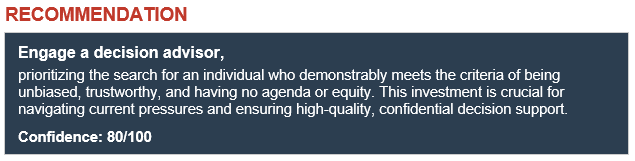
Click the button below to read, edit and print the full 4-page Executive Decision Brief for yourself:
The Bottom Line
In 2026, the question isn't whether founders need support.
The question is whether you're ready to climb with an ally who makes you sharper - without taking the rope from your hands.
A strategic ally should increase your clarity, speed, and confidence.
Anything else is noise.
Mike runs TEAM Solutions, providing strategic advisory for founders navigating the decisions, transitions, and isolation that come with scaling. His approach combines 25+ years of crisis leadership with practical decision frameworks - operational credibility, not consulting theory.
If you're weighing this decision for 2026 and are considering an ally: team-solutions.us/founders-ally