

Most soft skills training has a sequencing problem.
You take an active listening module. Then a feedback module. Then something on conflict resolution. Each one is packaged neatly, assessed cleanly, and checked off a list.
Then you walk into a real conversation and the wheels come off.
Not because you didn't learn the material - but because real conversations don't respect the sequence. They throw everything at you simultaneously.
The Moment Everything Shows Up at Once
Picture this: You're giving feedback to a peer who's been taking credit for joint work. You've prepared your opening line. You've thought through what you want to say.
Then they get defensive.
In that single moment you need:
- Self-Regulation — to stay calm and not match their energy
- Active Listening — to hear what's underneath the defensiveness
- Empathy — to understand why they're reacting this way
- Emotional Intelligence — to read whether to push forward or pause
- Conflict Resolution — to keep the conversation from derailing entirely
That's five of seven skills firing in approximately eight seconds. None of them in isolation. All of them tangled together, under pressure, in real time.
This is why people freeze. Not because they lack knowledge — but because they've never practiced the skills together the way they actually show up.
The 7 Skills and Why They're Interconnected
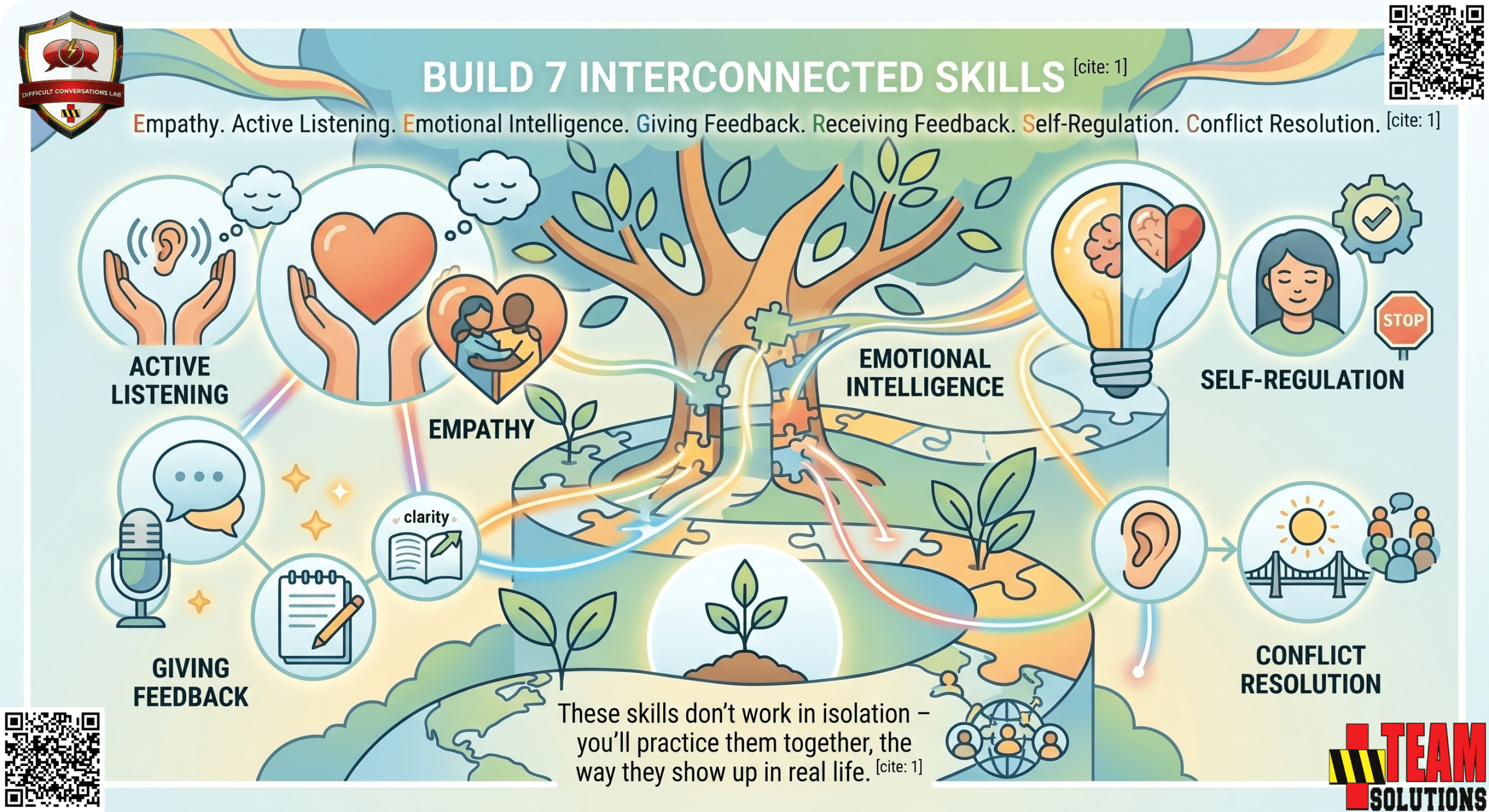
The Difficult Conversations Lab is built around seven skills that professionals need for any hard workplace conversation:
- Empathy
- Active Listening
- Emotional Intelligence
- Giving Feedback
- Receiving Feedback
- Self-Regulation
- Conflict Resolution
On the surface these look like a list. In practice they function like a system. Pull one out and the others weaken. Strengthen them together and something different happens - you stop dreading the conversation and start seeing a clear path through it.
Here's how they connect in the real world:
Empathy + Active Listening work together to help you understand what the other person actually needs - not just what they're saying. Without empathy, active listening is just data collection. Without active listening, empathy is just assumption.
Emotional Intelligence + Self-Regulation determine whether you stay in the conversation or get pulled out of it. EI tells you what's happening emotionally in the room. Self-Regulation is what you do with that information under pressure.
Giving Feedback + Receiving Feedback are two sides of the same moment. Most people practice one without the other. But in a real conversation, the roles flip. You deliver feedback and immediately have to receive the reaction - which is itself feedback about your delivery.
Conflict Resolution is the integration point. It's where all six of the other skills converge into an outcome. You can't resolve conflict without empathy, listening, emotional awareness, and the ability to both deliver and receive hard information.
What Practice Actually Looks Like
The reason most communication training doesn't translate to real conversations is that it's designed for comprehension, not performance. You can comprehend the concept of active listening and still fail to do it when your peer is getting defensive in real time.
Performance requires reps. Reps under realistic conditions. Conditions where the other person pushes back, deflects, and doesn't cooperate - the way real people actually behave.
That's the design principle behind the Difficult Conversations Lab. The AI practice coach doesn't go easy on you. It responds the way your actual coworker, manager, or direct report would - defensive, evasive, emotional. You practice until the skills stop being a checklist and start being instinct.
The Bottom Line
Soft skills aren't soft. They're the hardest skills to build precisely because they require you to perform under social and emotional pressure while managing a relationship in real time.
The good news is they're learnable. Not through videos and quizzes - but through deliberate practice with realistic resistance.
If you have a hard conversation coming up, or a pattern of avoiding them, the lab was built for exactly that.